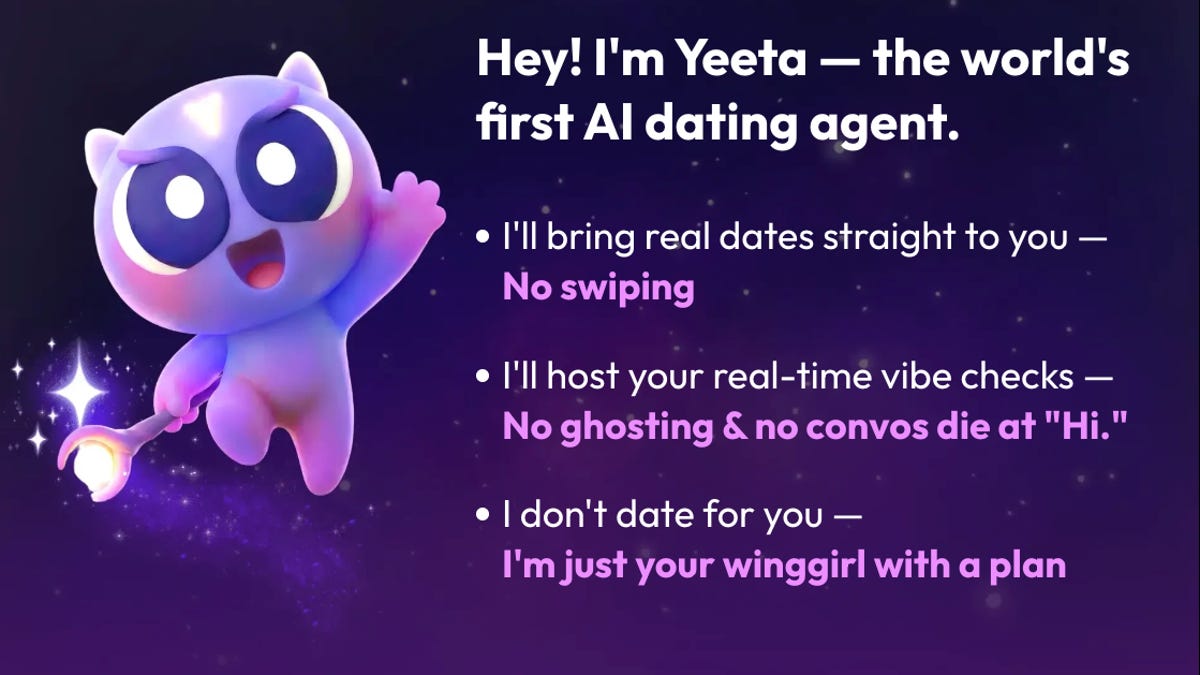
Yeet's AI Host Is Reality TV for Dating. Whether That Works Is the Real Question.
Key Points
- •Yeet emerged from beta with an artificial intelligence agent named Yeeta that hosts live, scheduled group video conversations for up to six singles simultaneously.
- •Yeet gathered 6,000 beta testers and 1,600 financial backers prior to launch, whereas competitor Snack reported 750,000 downloads shortly after its 2021 debut.
- •Pew Research data from 2023 indicates that 30 per cent of dating app users in the United States experienced frustration or felt overwhelmed by existing platforms.
- •Yeeta manages live participant selection and real-time conversation moderation, differing from platforms like Hinge and Tinder that use artificial intelligence primarily for matching prompts.
A new dating app has crossed a threshold most platforms have avoided: outsourcing the entire structure of getting to know someone to an AI algorithm. Yeet, which emerged from beta this month, deploys an artificial intelligence agent that hosts live group conversations between matches, controlling who talks, when, and about what. It's not a conversational nudge—it's full delegation of social choreography to software.
The app represents the industry's latest attempt to solve a persistent problem: what do you do when your core user base finds traditional dating apps exhausting? According to Yeet's positioning, the answer isn't better profiles or smarter swipes. It's removing choice architecture entirely and handing control to an AI that decides the parameters of human interaction.

This crosses a threshold most dating products haven't touched—automating not just discovery or icebreakers, but the facilitation of conversation itself. That raises questions about whether platforms are solving loneliness or just repackaging it with better production values. If Gen Z is genuinely too fatigued to browse profiles and structure their own conversations, that's a user behaviour shift operators need to understand.
Create a free account
Unlock unlimited access and get the weekly briefing delivered to your inbox.
If Gen Z is genuinely too fatigued to browse profiles and structure their own conversations, that's a user behaviour shift operators need to understand.
But if Yeeta is just reality TV gamification dressed up as innovation, it's a feature looking for a problem that doesn't exist at scale.
What Yeet is actually doing
The product mechanics matter here. Yeeta doesn't simply pair two people and suggest topics. It runs what the company describes as 'live dating show' sessions, with multiple participants simultaneously on video and audio. The AI acts as host, throwing out questions and managing turn-taking.
Sessions are time-bound and scheduled, not on-demand. Users don't swipe. They sign up for a slot, get matched by the AI, and join a group conversation.
Yeet claims this approach solves what it identifies as Gen Z's core frustrations: endless swiping, low-effort messaging, and the cognitive load of managing multiple chat threads. By moving interaction into structured, facilitated sessions, the company argues it removes friction and forces engagement. You can't ghost someone mid-session. You can't send 'hey' and disappear. The format demands presence.
The company disclosed it had more than 6,000 beta testers before launch and 1,600 people who financially backed the product during its development phase. Those figures are modest—especially the supporter count, which suggests limited commercial validation ahead of launch. For context, Snack, another video-first dating app targeting Gen Z, reported 750,000 downloads within months of its 2021 debut. Feels, which launched with voice-first matching, claimed 100,000 users in early traction. Yeet is starting significantly smaller.
What's genuinely novel here isn't AI in dating apps—Hinge, Tinder, and The League have all deployed algorithmic coaching, prompt suggestions, and behavioural nudges. It's the real-time moderation of live conversation. Other apps use AI to prepare you for interaction. Yeet uses it to run the interaction. That's a different product category.

The entertainment model comes to dating
Yeet's framing—calling Yeeta a 'host' and describing sessions as 'live dating shows'—isn't accidental. The product borrows heavily from reality TV conventions, where a third party structures and narrates romantic interaction. Love Island doesn't let contestants just chat freely. It engineers scenarios, prompts confessionals, and scripts dramatic beats. Yeet is applying that production logic to dating apps.
That might resonate with a generation raised on influencer culture and parasocial entertainment. But it also introduces performativity into what's ostensibly meant to be authentic connection. When an AI is steering the conversation and multiple people are watching, are participants genuinely getting to know each other or playing to an audience?
When an AI is steering the conversation and multiple people are watching, are participants genuinely getting to know each other or playing to an audience?
The industry has flirted with this tension before. Hinge's video prompts and Bumble's voice notes were pitched as authenticity tools, but they also turned profiles into curated performances. Yeet takes that further. Every interaction is a mini-production, with Yeeta as director. Whether that feels more genuine or less will determine if the format gains traction beyond early adopters who treat it as novelty.
What this signals about Gen Z product strategy
If Yeet gains meaningful traction—and that's a significant if, given its current scale—it could influence how other operators think about Gen Z product development. The prevailing industry narrative has been that younger users want video-first, asynchronous formats that let them show personality without endless texting. Apps like Snack, Lolly, and Feels have built around that thesis. Yeet's bet is different: that Gen Z doesn't want more self-directed optionality, but less. That they're paralysed by choice and would rather delegate social choreography to an AI.
That's either insight or projection. The evidence so far is thin. Yeet's beta tester count and financial backing suggest early interest, but nowhere near the scale needed to validate a new product paradigm. The company hasn't disclosed retention, session frequency, or match-to-date conversion. Without those metrics, it's impossible to assess whether AI-facilitated sessions actually drive outcomes or just generate novelty downloads.

Competing platforms should watch this, but they shouldn't pivot yet. The risk is that Yeet solves a problem most users don't have. Dating app fatigue is real—Pew Research found 30% of U.S. dating app users felt frustrated or overwhelmed by the experience as of 2023, and anecdotal reporting suggests that figure is higher among Gen Z. But it's unclear whether the solution is more mediation or less platform dependency altogether.
Handing conversation control to an AI could feel like relief or like surveillance, depending on execution. The broader question is whether dating apps are overengineering their way out of a trust and efficacy crisis. If users are fatigued, it might be because apps haven't delivered on their core promise—helping people meet compatible partners efficiently. Adding an AI host doesn't fix matching quality, local density, or the economic incentives that keep users scrolling instead of meeting. It just adds another layer of digital intermediation to a process many already find too mediated.
Yeet will either prove that Gen Z genuinely wants AI-run dating experiences, or it will become another cautionary tale about mistaking feature novelty for product-market fit. The company's modest early traction suggests the market hasn't decided yet. Operators should track whether Yeeta sessions convert to real-world dates—and whether users come back after the novelty wears off.
Key Takeaways
- •Dating app operators should monitor whether outsourcing conversation moderation to artificial intelligence improves long-term retention or merely creates temporary novelty downloads among Gen Z users.
- •Investors must evaluate if Yeet's reduction of user choice addresses real dating fatigue or simply overengineers digital intermediation without improving underlying match quality.
Frequently Asked Questions
Technology & AI Desk
The DII Technology Desk reports on product, engineering, AI and platform infrastructure across dating and social discovery apps.
Comments
Join the discussion
Industry professionals share insights, challenge assumptions, and connect with peers. Sign in to add your voice.
Your comment is reviewed before publishing. No spam, no self-promotion.