Meta Is Killing Messenger.com. The Users Who Hid From Facebook on It Deserve Better.
·5 min read
Meta will shut down the standalone messenger.com website in April 2026, redirecting desktop users to facebook.com/messages
Users who deactivated Facebook whilst keeping Messenger active—a configuration permitted since 2014—must now reactivate Facebook for desktop access
Messenger has become dating's "demilitarised zone" where singles migrate after matching on apps but before exchanging phone numbers
Mobile-only access remains available, but desktop functionality has been critical for managing multiple dating conversations
Meta is forcing thousands of daters into an uncomfortable choice: reactivate your Facebook profile to access desktop Messenger, or conduct all your early-stage romantic conversations on a mobile screen. The company disclosed this week that it will shut down the standalone messenger.com website in April 2026, redirecting all web traffic to facebook.com/messages. The timing couldn't be worse for dating app users who've spent years using Messenger as a neutral ground between app matches and phone number exchanges.
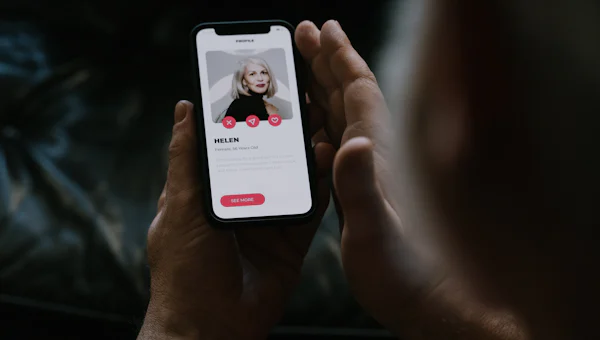
Person using smartphone for messaging
Over the past five years, Messenger has evolved into dating's demilitarised zone—the platform singles migrate to after matching on Hinge or Bumble but before exchanging phone numbers. It offered plausible deniability, basic safety through no phone number exposure, and crucially, complete separation from Facebook's social performance theatre. That separation is about to collapse.
For the subset of daters who deactivated Facebook years ago whilst keeping Messenger active—a configuration Meta has permitted since 2014—the consolidation presents a genuine dilemma. Desktop access now requires full re-engagement with Facebook's feed, notifications, and profile infrastructure. The alternative is mobile-only messaging, which Meta confirmed will remain available through the standalone app.
Enjoying this article?
Join DII Weekly — the dating industry briefing, delivered free.
The DII Take
Meta is effectively taxing the offramp behaviour that dating apps quietly rely on—the gradual migration of conversations away from platform.
This isn't a catastrophic moment for the dating industry, but it's a meaningful friction point that operators should understand. The cohort most affected—privacy-conscious younger users who've already left Facebook—overlaps substantially with dating apps' highest-value demographics. If even a fraction abandon Messenger as a transition channel, expect more premature phone number exchanges or, more likely, more conversation death as users balk at the escalation.
Someone at Match Group (MTCH) should be modelling what happens when the lowest-friction messaging alternative suddenly requires Facebook reactivation. The implications for conversion rates and engagement funnels could be material over the next 18 months.
The decade-long workaround Meta is closing
Meta's original 2014 decision to spin Messenger into a standalone property responded directly to user demand for messaging without social context. Facebook's product team recognised that many conversations—particularly personal, one-to-one exchanges—were undermined by the platform's social performance dynamics. The dedicated Messenger app and messenger.com website let users communicate without navigating feeds, friend suggestions, or profile updates.
Mobile phone showing messaging interface
That separation proved particularly valuable for dating. According to Meta's own usage data, Messenger became one of the most common platforms for early-stage romantic communication, sitting between the relative anonymity of dating app chat and the commitment signal of phone number exchange. The service offered video calling, disappeared messages, and reasonable privacy controls without requiring phone contact details—features that dating app operators have spent years trying to replicate in-house.
The configuration also worked for daters who'd opted out of Facebook entirely. Meta has permitted users to maintain Messenger access with a deactivated Facebook account since the platforms separated. For privacy-conscious singles, this arrangement was optimal: maintain practical communication channels whilst avoiding social media's mental health toll and privacy concerns.
Dating app users managing multiple concurrent conversations—standard behaviour in the early matching phase—rely heavily on desktop interfaces whilst working or at home.
Typing longer messages, sharing links, and conducting video calls are all meaningfully easier on a laptop than a phone. The shift to mobile-only access for Facebook refuseniks isn't catastrophic, but it's genuinely less functional. Anyone who's tried to manage multiple concurrent dating conversations on a phone whilst working from a laptop knows that's not a comparable experience.
Laptop computer on desk for desktop messaging
Meta's stated rationale, according to the company's help documentation, focuses on simplifying its messaging infrastructure. By retiring the standalone website and the previously discontinued desktop apps for Windows and Mac, Meta reduces duplicate maintenance whilst consolidating user traffic onto facebook.com properties. The business logic is straightforward: fewer platforms to support, more users funnelled to the advertising-supported Facebook environment.
What dating operators should watch
The immediate impact on dating apps will be subtle rather than dramatic. Messenger isn't disappearing, and most daters use it primarily on mobile anyway. But friction matters at the margins, particularly in early-stage courtship where abandonment rates are already high.
Dating platforms have spent years encouraging users to keep conversations on-platform longer, recognising that every migration to external messaging represents potential disengagement from the app. Features like video calling, voice notes, and disappearing messages were all designed to delay the exodus to WhatsApp, iMessage, or Messenger. If Meta makes Messenger marginally less convenient for a meaningful user segment, that calculus shifts.
The larger strategic question is whether this marks an inflection point in how younger daters think about Meta's platforms. The cohort that's already left Facebook—largely users under 30, who comprise dating apps' core demographic—made that exit because they rejected the platform's social dynamics. Forcing them back, even just for messaging, risks accelerating migration to genuinely independent alternatives like Telegram or Signal.
For operators, the challenge is that they can't control the external messaging ecosystem, but they depend on it functioning smoothly. The gradual offramp from app chat to external messaging to phone contact is how modern dating courtship works. When one of those steps becomes more complicated—even slightly—conversion rates will shift.
Monitor time-to-message-migration and conversation persistence rates over the next 18 months to detect behavioural shifts caused by Meta's consolidation
Watch for potential acceleration in migration to independent messaging alternatives like Telegram or Signal among younger users who reject Facebook's ecosystem
Consider whether in-app messaging features need enhancement to compensate for increased friction in the external messaging offramp that dating courtship depends on