Match Group's 'Readiness Paradox': A Retention Strategy in Disguise?
·6 min read
80% of Gen Z believe they'll find lasting love, but only 55% feel ready for partnership now—a 25-percentage-point gap Match Group calls the 'readiness paradox'
42% of Gen Z have seen a therapist compared to 26% of Gen X, with Match Group suggesting therapeutic engagement raises the bar for relationship 'readiness'
Research conducted via Harris Poll across 2,500 US adults, with no disclosed breakdown of socioeconomic status, geography, or racial composition
Match Group's revenue model depends on prolonged app usage without relationship formation—the exact behaviour its research now frames as requiring product accommodation
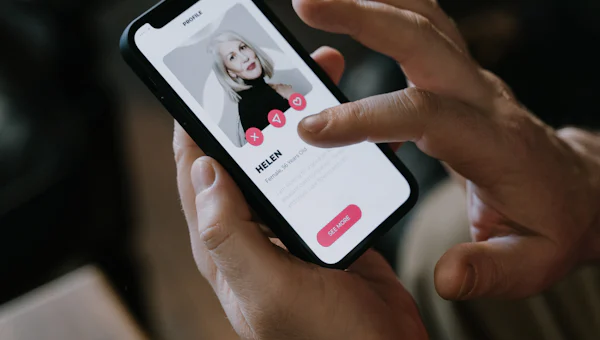
Match Group has published research claiming to explain why Gen Z wants love but can't commit to it, and the timing couldn't be more convenient. Just as investors question whether dating apps solve or prolong the problems they're meant to address, the company behind Tinder, Hinge, and OkCupid has produced data suggesting young people's relationship delays aren't a product bug—they're a feature the industry should accommodate. What the research doesn't acknowledge is that Match Group's revenue model depends entirely on this commitment gap remaining wide.
Young couple using dating app on mobile phone
The research, conducted via Harris Poll across 2,500 US adults, centres on what Match Group calls the 'readiness paradox': 80% of Gen Z believe they'll find lasting love eventually, but only 55% feel ready for partnership now. The company frames this 25-percentage-point gap as a generational shift in emotional maturity standards, driven by therapy culture, boundary-setting, and social media anxiety. The proposed solution? Dating app features designed for 'low-pressure' interactions that keep users engaged longer before coupling off.
The DII Take
This is corporate research in service of corporate strategy, dressed up as consumer insight. Match Group has identified a behaviour pattern that happens to align perfectly with its business interests—prolonged app usage without relationship formation—and reframed it as a psychological phenomenon requiring product accommodation rather than a market failure requiring solution.
The 'readiness paradox' may well be real, but a dating company diagnosing commitment delay as something to design around rather than solve is akin to a gym chain celebrating members who pay but never cancel. The conflict of interest is hard to ignore.
Enjoying this article?
Join DII Weekly — the dating industry briefing, delivered free.
Therapy culture as revenue retention
The research leans heavily on Gen Z's relationship with therapy as explanatory context. According to Match Group's figures, 42% of Gen Z have seen a therapist compared to 26% of Gen X, and the company suggests this therapeutic engagement has raised the bar for what constitutes 'readiness' for partnership. Women in particular, the data indicate, view therapy and established boundaries as prerequisites for relationship viability.
This framing positions therapy as a contributor to relationship delay, which is a significant interpretive leap. The causation could run the opposite direction: perhaps Gen Z delays relationships because economic precarity, housing unaffordability, and climate anxiety make long-term planning feel futile, and therapy is where they process that structural dysfunction rather than what causes the delay. Match Group's research doesn't distinguish between correlation and causation, nor does it consider that higher standards for emotional health might reduce bad relationships rather than delay good ones.
Person reflecting on relationships during therapy session
For dating operators, though, the implication is clear. If your user base has genuinely shifted toward viewing years of personal development as a relationship prerequisite, your monetisation window has expanded dramatically. The average Tinder subscriber who stays single for an extra two years whilst 'working on themselves' represents 24 additional months of revenue. Whether Match Group is describing a generational evolution or accidentally revealing its retention strategy depends on how generously you read the data.
Social media theatre and hard launches
The research also highlights Gen Z's reluctance to 'hard launch' relationships on Instagram—the practice of publicly confirming a partnership through photos and captions—as evidence of commitment anxiety. According to Match Group, fear of public performance and potential embarrassment if relationships end contributes to young people keeping connections private longer, preferring ambiguous 'soft launches' instead.
This behaviour isn't new. Relationship ambiguity has existed as long as relationships have. What's changed is that Instagram and TikTok have monetised it. Platforms algorithmically reward relationship drama content—breakup announcements, 'he's toxic' videos, and relationship speculation generate significantly more engagement than stable partnership updates.
Match Group's framing treats social media anxiety as an external factor shaping dating behaviour, but the company's own apps operate on identical engagement-driven models. When Match Group identifies 'low-pressure' features as the solution to commitment hesitancy, what it's actually describing is features that extend the pre-commitment phase—precisely the period when dating app usage and revenue are highest.
The sample and the narrative
The 2,500-person US sample is worth scrutinising. Match Group hasn't disclosed the socioeconomic breakdown, geographic distribution, or racial composition of respondents. Gen Z is the most diverse generation in American history, and relationship formation patterns vary significantly by class, geography, and cultural background. Research that treats Gen Z as a monolithic cohort risks describing the behaviour of college-educated coastal urbanites whilst claiming to explain a generation.
Young adults socialising and connecting in urban setting
There's also no international comparison. Gen Z commitment patterns in the UK, where housing costs have priced an entire generation out of stability, may look different from those in Germany, where apprenticeship systems still offer economic security, or in Southern Europe, where multi-generational households remain common. A US-only sample can't support claims about generational behaviour without acknowledging that American economic and cultural conditions aren't universal.
Match Group is positioning this research as the foundation for product development—Tinder's Double Dating and College Mode features are explicitly framed as responses to the readiness paradox. But these features don't solve commitment delay. They extend the casual dating phase, which is exactly what a subscription business wants.
What operators should watch
The tension here matters beyond Match Group. If the readiness paradox is real and generational, every dating operator will need to reckon with a user base that wants relationships eventually but not yet, and design for monetising the 'not yet' phase without becoming complicit in prolonging it indefinitely. If it's not real—if it's selection bias in a company-commissioned survey—then the industry is at risk of designing products around a problem that doesn't exist, or worse, around a problem the products themselves create.
Competitors will face pressure to respond to Match Group's framing whether or not they agree with it. Bumble (BMBL) has already positioned itself around women making the first move; does it now add 'readiness' filters or therapy integration? Grindr (GRND) serves a user base with different relationship formation patterns; does the paradox apply there, or is this heteronormative hand-wringing? Niche platforms built around shared values or life stages may find themselves advantaged if 'readiness' becomes a sorting mechanism users actually want rather than a delay tactic monetised by platforms.
The broader question is whether dating apps are in the business of facilitating relationships or managing the prolonged single phase. Match Group's research suggests the company has chosen the latter and is now producing the academic cover for it. As dating culture shifts toward clearer commitment standards, the industry must decide whether to accommodate ambiguity or accelerate clarity—and which choice actually serves users versus shareholders.
The conflict between Match Group's business model and user outcomes has never been starker—prolonged singlehood is being reframed as a feature to design around rather than a problem to solve
Competitors must decide whether to follow Match Group's lead in monetising relationship delay or differentiate by accelerating commitment outcomes, with significant strategic implications either way
Watch for whether 'readiness' features become industry standard or whether backlash emerges from users who recognise these tools extend rather than resolve their search for partnership