Discord Misclassified 90% of Users as Adults. Age Verification Cannot Be This Hard.
·6 min read
Discord classified 90% of users as adults using behavioural signals alone—account tenure, payment history, and participation patterns—without requiring ID verification
The platform delayed global age verification rollout by six months to the second half of 2025 following user backlash over perceived mandatory facial scans
A data breach in October 2025 exposed identity documents for approximately 70,000 users, prompting Discord to sever that vendor partnership
Match Group's revenue declined 3% year-over-year in Q4 2024 whilst Bumble's paying user count fell 5% in the same period
Discord's attempted age verification rollout has turned into an industry masterclass in how to alienate your user base whilst simultaneously revealing that most platforms probably don't need invasive ID checks at all. The chat platform delayed its global implementation by six months after users revolted against what they perceived as mandatory facial scans and document uploads—only to clarify that 90% of its users were never going to be asked to verify in the first place. The communication failure is instructive, but the real story for dating operators is what Discord quietly admitted in the process: that behavioural signals are sufficient to classify the vast majority of users as adults without ever asking for a government-issued ID or a biometric scan.
Digital identity verification concept
Discord's climbdown proves that the default march towards document-based verification isn't inevitable—it's a choice, and often a lazy one.
Dating platforms have vastly more behavioural data than Discord—messaging patterns, profile completion, subscription history, social graph maturity—yet most are still defaulting to ID uploads when regulators come knocking. The question isn't whether signals-based verification works. It's why dating apps aren't already using it.
What 90% Actually Means
According to Discord's own figures—and these are internal estimates, not independently verified—nine in ten users have already been classified as adults through existing data points. CTO Stanislav Vishnevskiy disclosed that these signals include account tenure, payment method presence, and participation in adult-oriented communities. Those users won't see a verification prompt. They won't lose access to features.
Enjoying this article?
Join DII Weekly — the dating industry briefing, delivered free.
Only the remaining 10% will face any friction. That cohort includes users accessing age-restricted content, accounts flagged through moderation activity, and profiles that lack the signals Discord considers indicative of adult status. Even then, Discord has expanded verification methods beyond the initial facial age estimation and ID upload options. A credit card verification route will launch before the global rollout in the second half of 2025.
The contrast with dating industry practice is stark. Match Group has rolled out ID verification across multiple brands, with Tinder expanding the optional feature globally. Bumble introduced government ID checks in 2021. Grindr has implemented age verification in markets facing regulatory pressure. None has publicly discussed using behavioural signals to minimise the friction of compliance.
The Vendor Problem and the Breach Nobody Discussed Enough
Discord's pivot away from invasive verification comes amid two developments that dating platforms should find uncomfortable. First, the company confirmed it has ended its limited UK trial with Persona, the Founders Fund-backed verification vendor. The decision followed what Vishnevskiy described as 'significant feedback' from users concerned about privacy and the vendor's connections.
Data security and privacy protection
Second, Discord referenced the October 2025 data breach that exposed identity documents for approximately 70,000 users. The company didn't name the vendor involved in that incident but confirmed it has severed that partnership. The breach underscores the security liability inherent in storing biometric and document data, a risk that compounds when verification is outsourced.
Dating platforms hold vastly more sensitive user data than Discord—location history, sexual orientation, HIV status on some platforms, private messages—and are adding ID scans to that attack surface. The regulatory environment isn't giving operators much room. The UK Online Safety Act imposes age verification requirements on platforms hosting user-generated content. The EU Digital Services Act mandates age-appropriate design for minors. Australia has passed legislation requiring age checks for under-16s.
Why Dating Apps Have More Data Than Discord but Less Imagination
Dating platforms collect behavioural signals that Discord can only dream of. They know whether a user has maintained a profile for years, whether they've subscribed with a credit card, whether their messaging patterns reflect adult communication. They track location consistency, social graph maturity, and interaction history across potentially millions of conversations. Match Group disclosed in its Q3 2024 earnings that Tinder alone processes 1.6 billion swipes daily.
If a chat app can classify 90% of users through signals alone, dating platforms—with richer data and clearer adult-intent markers—can make an even stronger case for non-invasive methods.
Yet the industry default remains ID upload. Partly, this reflects regulatory conservatism—when a regulator demands age verification, the safest legal response is the most literal one. Partly, it's vendor-driven. The age verification market has coalesced around document and biometric solutions because those companies got to regulators and platforms first. And partly, it's simply that dating executives haven't prioritised building proprietary classification models when a third-party integration is available off the shelf.
Discord's experience suggests that approach may be shifting from convenient to untenable. The platform's initial announcement in February triggered immediate backlash, with users threatening to abandon the service rather than submit to facial scans. Dating apps face the same dynamic, but with higher stakes. None of these companies can afford a user revolt over verification friction, particularly when behavioural signals offer a plausible alternative that Discord has now validated publicly.
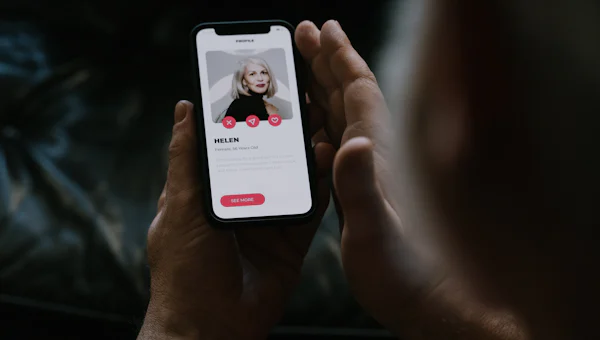
Mobile dating application interface
What Operators Should Actually Do
The Discord climbdown creates political cover for dating platforms to push back on document-based verification mandates. Regulators want age assurance, not necessarily ID scans. If a chat app can classify 90% of users through signals alone, dating platforms can make an even stronger case for non-invasive methods.
The technical lift isn't trivial. Building a classification model requires data science resources, ongoing validation, and willingness to accept some false positives. But the alternative is accumulating millions of identity documents, outsourcing verification to third parties with uncertain security practices, and waiting for the inevitable breach that exposes not just IDs but the context that someone used a dating app.
Discord's delay to the second half of 2025 gives the dating industry a window. Regulators are watching this rollout. So are privacy advocates, users, and investors tracking the trust crisis across social platforms. The companies that move first on signals-based verification won't just reduce compliance risk—they'll own the narrative before the next regulatory cycle forces the conversation.
Dating platforms should develop proprietary behavioural classification models before the next regulatory cycle forces expensive document-based solutions that users will resist
The technical case for signals-based age verification is now validated by Discord's public admission—operators have the political cover to push back on invasive ID mandates
Accumulating millions of identity documents creates compound security liability for platforms already holding sensitive location, orientation, and messaging data vulnerable to breach