Dating Apps Face Evolutionary Ceiling: Can They Profitably Adapt?
·5 min read
Match Group spent $182M on product development last year whilst user satisfaction scores continue to slide across major platforms
Dr. Justin Garcia of the Kinsey Institute argues dating apps are "divorced from how we've engaged in courtship for millions of years"
Bumble's premium ARPU grew just 3% year-over-year in Q1 2024 despite significant feature additions including voice and video
Major platforms have systematically added voice notes, video chat, and IRL events as retention tools for maturing user bases facing fatigue
Match Group spent $182M on product development last year. Bumble has poured resources into AI-powered features and video chat. According to Dr. Justin Garcia, executive director of the Kinsey Institute, they're all working against four million years of hardwired human biology.
Garcia's argument, delivered in an interview with Mashable, cuts to the core of the dating app business model: the platforms are 'divorced from how we've engaged in courtship for millions of years'. Humans evolved to assess potential partners through multisensory interaction—voice, body language, scent, touch, social context. Dating apps offer photos and text.
The mismatch, Garcia argues, explains why 'these technologies are becoming more popular and more pervasive and more advanced, but they're still not at a place where they're overturning four million years of evolution in terms of our desire to form intense bonds'. The timing of this critique matters. User satisfaction scores have been sliding across major platforms, revenue growth is slowing, and operators are frantically testing features that move beyond the swipe.
Enjoying this article?
Join DII Weekly — the dating industry briefing, delivered free.
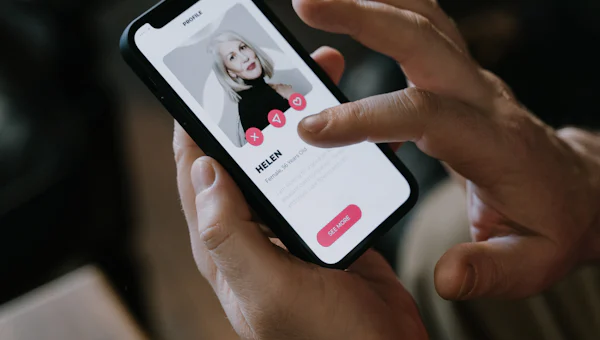
Person using dating app on smartphone
The DII Take
Garcia is saying what product teams already know but can't publicly admit: the core swipe-match-message loop may have an evolutionary ceiling.
The industry's frantic pivot to video features, voice notes, and IRL events isn't just about engagement metrics—it's a tacit acknowledgement that text-based matching can't deliver what millions of years of courtship behaviour demand. The question isn't whether Garcia is right. It's whether dating apps can profitably bridge the gap between their scalable digital model and our hardwired need for multisensory assessment.
The product development implications
Every major platform now offers features that gesture towards Garcia's critique. Bumble added voice notes in 2021 and video chat in 2020. Hinge introduced voice prompts in 2022. Match Group's Plenty of Fish launched live streaming.
What's interesting is the sequence. These features arrived not as launch differentiators but as retention tools for maturing platforms facing user fatigue. According to Bumble's Q1 2024 earnings call, features that 'bring personality to life' drove measurable engagement increases. Match Group disclosed in its Q4 2023 transcript that video and audio features correlated with longer session times and higher conversion to first dates.
The pattern suggests Garcia's analysis isn't merely academic. Product teams are responding to signals that static profiles don't satisfy. But the solutions remain constrained by the apps' fundamental architecture: asynchronous, remote, filtered through screens.
Video chat conversation on mobile device
The evolutionary mismatch Garcia describes helps explain why dating app founders keep launching IRL event businesses. Bumble acquired Geneva Social Club assets and has expanded For You events. Hinge ran We Met IRL activations in six cities last year. These aren't marketing stunts—they're admissions that the app alone can't deliver what courtship requires.
The business model tension
Dating apps monetise attention, not outcomes. Subscriptions, boosts, and Super Likes generate revenue when users stay on the platform, not when they pair off successfully. This creates a structural misalignment that Garcia's critique throws into relief.
If humans are hardwired to assess partners through multisensory interaction, and if apps can't deliver that experience profitably at scale, the industry faces a ceiling.
You can't bottle pheromones into a freemium feature. You can't monetise body language through a £29.99 monthly subscription. Voice and video add cost without proportionally increasing willingness to pay—Bumble's premium ARPU grew just 3% year-over-year in Q1 2024 despite significant feature additions.
The competitive response has been to add features that approximate physical presence whilst maintaining digital scalability. But the approximation may be the problem. Garcia's framework suggests that users will remain fundamentally unsatisfied until they get the full sensory package—and that package doesn't fit the app-based business model.
People meeting in person at social event
Operators face a choice. Double down on algorithmic matching and accept the evolutionary ceiling Garcia describes, or pivot towards facilitating offline interaction and accept lower engagement metrics. Neither path is straightforward. The former risks chronic user dissatisfaction and churn. The latter undermines the core product and invites questions about whether you're still a technology company.
The four-million-year qualifier
Garcia's four-million-year figure deserves scrutiny. Modern humans emerged roughly 300,000 years ago. He's likely referencing broader hominin evolution or the deeper mammalian roots of pair bonding. Either way, the specific timeframe matters less than the directional claim: human courtship behaviour is ancient, and dating apps are a decade old.
That said, this represents one prominent researcher's perspective, not settled academic consensus. The Kinsey Institute carries significant authority in human sexuality research, but Garcia's critique isn't drawn from peer-reviewed studies comparing app-based courtship to evolutionary models. It's expert opinion, well-informed but not empirical proof.
What the industry can't dismiss is the pattern Garcia identifies. Dating app design genuinely is divorced from multisensory assessment. Whether that gap is evolutionarily insurmountable or merely an engineering challenge remains open. But the user satisfaction data suggests the gap is real.
The industry's product roadmap for the next 18 months will test Garcia's thesis. If platforms continue layering on voice, video, and IRL features whilst maintaining healthy unit economics, the evolutionary mismatch may be bridgeable. If engagement and satisfaction remain flat despite these additions, operators will face a harder truth: you can't swipe your way past four million years of biology, and the apps that win will be those that stop trying.
Watch whether new multisensory features (voice, video, IRL events) actually improve user satisfaction and retention metrics over the next 18 months—flat results would validate Garcia's evolutionary ceiling thesis
The fundamental business model tension is unresolved: dating apps monetise attention and engagement, not successful pairings, creating structural misalignment with user goals
Operators face a strategic choice between doubling down on digital matching (risking chronic dissatisfaction) or pivoting to offline facilitation (undermining the scalable tech model that justifies current valuations)