Partiful's Crush: The Real Threat to Dating Apps' Core Logic
·5 min read
Match Group's Tinder saw average revenue per paying user decline 2% year-on-year in Q2 2025, whilst Bumble reported flat paying user growth
63% of men and 53% of women under 30 report feeling 'worn out' by dating apps, according to Pew Research Centre data from early 2024
Match Group generated $3.19B in revenue in 2024, compared to Bumble's $934M, almost entirely from subscriptions and à la carte features
Partiful's Crush feature allows users to anonymously mark up to 10 'Mutuals' as romantic interests, with matches unlocking direct messaging
Match Group and Bumble have spent three years engineering ways to push users from digital profiles to physical meetings. Partiful just flipped the entire model on its head. The event planning app's new Crush feature lets users convert real-world chemistry into digital follow-through, monetising the post-party awkwardness that traditional dating apps never touch.
The feature launched in select US markets in late December and is expanding ahead of Valentine's Day 2026. Users mark people they've attended events with as romantic interests, and mutual matches unlock messaging. Rather than manufacture attraction through algorithms and profile optimisation, Partiful is betting it can own the reverse journey—from in-person meeting to digital connection.
The IRL-first dating model arrives
What Partiful has built is structurally different from anything incumbent dating platforms offer. Tinder, Hinge, and Bumble operate on manufactured serendipity: show users profiles, manufacture attraction through photographs and prompts, then hope the resulting match translates to chemistry. The conversion rate from match to meeting remains abysmal across the category.
Enjoying this article?
Join DII Weekly — the dating industry briefing, delivered free.
People socialising at an event
Crush starts after chemistry has already been established. Users aren't evaluating static profiles or optimising for algorithmic visibility. They're converting genuine in-person interest into a digital follow-through mechanism. The friction it removes isn't 'will this person be attractive?'—it's 'will I look desperate if I message them?'
That's a narrower problem to solve, but it's also the one that dating apps have consistently failed to address once their users actually meet someone they like outside the platform.
The timing matters. Gen Z has become vocal about swipe fatigue and the commodification of romantic connection on platforms optimised for engagement metrics rather than actual relationships. Bumble reported in November 2025 that paying user growth had flatlined quarter-on-quarter.
This is the most credible structural threat to traditional dating apps in years—not because Partiful will replace them overnight, but because it exposes the fundamental weakness in their product logic. Dating operators have spent billions trying to make digital profiles feel real. Partiful skips that entirely and monetises the gap between meeting someone and working up the nerve to text them.
From event coordination to social infrastructure
Partiful launched in 2020 as an event invitation tool, initially adopted by university students and young professionals frustrated with Facebook Events' declining utility. The platform's growth has been largely organic, driven by creating shareable party links, tracking RSVPs, and coordinating logistics.
Group of friends using smartphones
What's shifted over the past 18 months is the company's expansion beyond that single job-to-be-done. Partiful has added user profiles, event feeds showing which gatherings friends plan to attend, photo sharing from parties, and interactive features reminiscent of Facebook's early social mechanics. Crush is the logical extension of that infrastructure buildout.
The company isn't pivoting from events to dating—it's layering monetisable social features atop a distribution channel it already owns.
That trajectory matters. Standalone dating apps have to acquire users cold, convince them to create profiles, and retain them through a product experience that inherently frustrates. Partiful already has users showing up repeatedly for its core event product. Crush is an upsell to an existing behaviour, not a new habit to create.
The cofounders have framed Crush as solving 'post-event hesitation', the universal experience of meeting someone at a party and then agonising over whether reaching out would seem too forward. People already use Partiful to see who's attending which events. Letting them convert in-person interest into a low-stakes mutual match is a feature extension, not a category redefinition.
What's missing: data, monetisation, and scale
For all the narrative appeal, Partiful hasn't disclosed user numbers, growth rates, or geographic penetration. 'Rapidly grown' is the company line, but without figures we don't know if that means 500,000 users or 5 million. The distinction matters enormously.
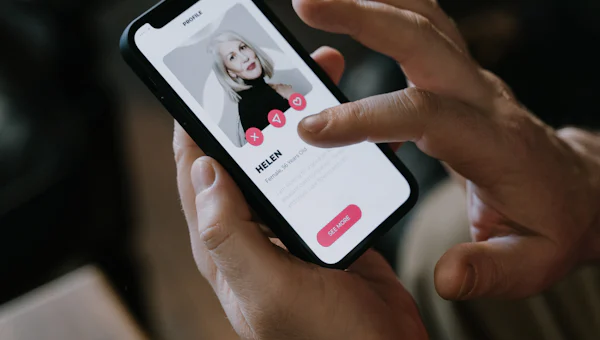
Person using dating app on mobile phone
Dating apps benefit from network density—the more users in your city, the more valuable the product becomes. If Partiful's footprint is concentrated in a handful of US metros with high student populations, Crush is a clever feature for a niche product. If it's distributed across dozens of cities with meaningful event volume, it's a platform play.
Monetisation remains entirely unclear. Partiful hasn't announced premium tiers, subscription models, or advertising plans. The Valentine's Day 2026 rollout suggests commercial intent, but whether that means charging for unlimited Crush selections, premium messaging features, or something else is unspecified.
The competitive response will be swift if Crush gains traction. Hinge could add event-based matching. Bumble could build party coordination features and layer dating functionality on top. Eventbrite could add mutual interest mechanics to its RSVP data. None of those moves require technical innovation—they require product prioritisation and a willingness to cannibalise existing revenue streams.
What happens next depends on whether Crush can scale beyond early adopters and whether Partiful can convert romantic matches into a revenue model that doesn't alienate its user base. The company has until late February to prove the feature has legs. If match rates are high and engagement holds, expect other platforms to test similar mechanics by summer 2026.
If it fizzles, it'll be remembered as a clever feature that solved a real problem for too narrow a segment to matter. Either way, dating operators should be watching closely. The last time someone challenged the swipe-first model this directly, it was called Bumble, and Match Group spent $400M trying to copy it.
Watch whether Partiful can articulate a monetisation strategy that doesn't alienate its user base—subscriptions, premium features, or advertising will signal whether this is a feature or a platform play
Expect rapid competitive response if Crush gains traction beyond early adopters. Incumbents like Hinge, Bumble, and Eventbrite could layer similar mechanics onto existing products by summer 2026
The real test is network density and match rates through late February 2026. If engagement holds beyond the Valentine's Day marketing window, the dating category faces its first credible structural threat since Bumble launched in 2014