Women Are Going to Medieval Times to Feel Safe. Dating Apps Should Be Embarrassed by That.
·6 min read
45% of female dating app users report feeling 'overwhelmed' by potential matches, compared to 26% of men (Pew Research, 2023)
Women aged 18-34 report significantly higher rates of 'emotional exhaustion' from app use than any other demographic
Medieval Times operates nine US venues and one in Toronto, reporting revenue growth post-pandemic
The 'romantasy' publishing genre has moved millions of units, driven largely by BookTok and female readers under 35
Medieval Times isn't a dating venue. But according to psychologists tracking the behavioural patterns of young women aged 18-35, it's increasingly functioning as one—or at least as a carefully curated alternative to the emotional labour of maintaining a Hinge profile. The dinner theatre chain, known for jousting knights and roast chicken eaten without cutlery, has reportedly seen a surge in young female attendance, with stated motivations centring on a desire to 'swoon over male performers' in an environment where chivalry is scripted, commitment is time-limited, and rejection is structurally impossible.
Dr Courtney Cantrell, a licenced psychologist, framed the phenomenon bluntly in comments to US media: 'Dating apps create too many choices, attention but lack of commitment—causing burnout. An environment like Medieval Times creates a sense of safety because everyone is playing a role.' It's a neat thesis. Whether it's actually about dating is another matter entirely.
The DII Take
This story tells us more about the state of dating app sentiment than it does about Medieval Times' business model. That young women are choosing themed dinner theatre—an activity requiring advance planning, physical travel, and a ticket price—over free, frictionless app access signals something more fundamental than escapism. It suggests a growing cohort willing to pay for experiences that guarantee emotional safety at the expense of romantic possibility.
Enjoying this article?
Join DII Weekly — the dating industry briefing, delivered free.
Dating operators should read this as a referendum on psychological cost, not on product features.
Medieval themed entertainment venue with performers
The romantasy economy is real, but is it dating-adjacent?
The broader cultural context supports at least part of the narrative. The 'romantasy' genre—fantasy fiction with romantic storylines, often featuring morally ambiguous warriors and court intrigue—has become a publishing juggernaut. Authors like Sarah J. Maas and Rebecca Yarros have moved millions of units, driven largely by BookTok recommendations and a demographic that skews heavily female and under 35. HBO's A Knight of the Seven Kingdoms, the latest Game of Thrones prequel, launched to strong viewership in January 2025, leaning into chivalric aesthetics and idealised notions of honour.
Medieval Times, which operates nine castle-shaped venues across the US and one in Toronto, has benefited from this cultural moment. The company's parent, Medieval Times Entertainment, reported revenue growth following the pandemic, though precise figures remain privately held. Industry observers note increased interest in participatory, immersive entertainment formats—escape rooms, immersive theatre, Renaissance faires—that position attendees as participants rather than passive consumers.
What's less clear is whether young women attending these events view them as dating-adjacent activities or as pure entertainment with a parasocial romantic veneer. The psychologists quoted in media reports suggest the former. The evidence, such as it exists, is largely anecdotal.
What dating app fatigue actually looks like
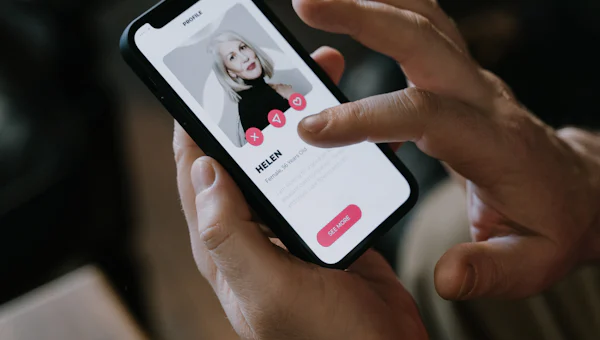
Dating app burnout is well-documented, particularly among women. Pew Research data from 2023 found that 45% of female app users reported feeling 'overwhelmed' by the volume of potential matches, compared to 26% of men. A 2024 study published in the Journal of Social and Personal Relationships found that women aged 18-34 reported significantly higher rates of 'emotional exhaustion' related to app use than any other demographic, citing unreciprocated effort, time investment, and the cognitive load of filtering intent signals.
Woman using mobile dating application
Match Group (MTCH) has acknowledged the sentiment issue in earnings calls, though executives frame it as an opportunity for product refinement rather than existential threat. Bumble (BMBL) has positioned features like 'Opening Moves'—pre-written conversation starters—as friction reducers, though user response has been mixed. Grindr (GRND), whose user base skews male, has faced less public pressure on the burnout narrative, though churn remains a key metric across all operators.
The question is whether fatigue translates into structural behaviour change or temporary disengagement. Attending Medieval Times once or twice a year as a form of escapist entertainment doesn't constitute an exit from dating apps. It might, however, signal a willingness to explore alternative social formats—particularly those that offer emotional reward without transactional risk.
The theatrical safety trade-off
Dr Cantrell's observation about 'everyone playing a role' is the most revealing part of the narrative. Medieval Times is structured to eliminate ambiguity. Knights perform valour. The queen character bestows favour. Attendees cheer, eat, and leave. There's no ghosting, no mixed signals, no three-day text delay to decode.
That model offers something dating apps cannot: guaranteed emotional resolution within a two-hour window.
The trade-off, of course, is that the resolution is entirely fictional. No one is meeting a partner at Medieval Times, unless they're meeting another attendee in the queue for the gift shop—and even then, the venue's design doesn't facilitate connection between strangers in the audience.
This is where the psychologist framing risks overstating the case. Escapism is not the same as substitution. Women attending themed dinner theatre for a dose of performative chivalry are not necessarily rejecting dating apps as a category; they may simply be managing the psychological tax of sustained app use by scheduling occasional breaks that feel romantically coded without requiring vulnerability.
What operators should actually watch
If this behaviour pattern scales—and that's a significant if—the implication for dating platforms isn't that they'll lose users to dinner theatre. It's that they may be competing for attention and emotional bandwidth with a broader category of 'romantic-adjacent experiences' that offer lower stakes and higher guaranteed satisfaction.
Social gathering and entertainment event
That category already includes book clubs, live music events, fitness classes, and travel groups marketed with subtle romantic framing. The common thread is shared activity with plausible deniability: you're there for the thing, not explicitly to date, which reduces perceived risk.
Dating operators experimenting with events-based features—Match Group's Stir app for single parents, Bumble's IRL activations, Hinge's 'designed to be deleted' positioning that subtly valorises offline connection—are already attempting to capture this dynamic. The challenge is monetising it. Ticket sales for Medieval Times are straightforward. Attendance at a dating app's sponsored mixer is murkier, particularly when the goal is ostensibly to get users off the platform.
The other risk, for apps and for the broader dating ecosystem, is that the theatre model becomes appealing precisely because it doesn't lead anywhere. If young women are choosing fantasy over possibility, that's not a product problem. It's a signal that the psychological cost of pursuing real romantic connection has exceeded the perceived benefit—at least temporarily. No amount of product iteration fixes that.
Whether Medieval Times becomes a meaningful trend or a fleeting cultural curiosity depends on whether attendance translates into repeat behaviour and whether other immersive entertainment formats see similar demographic shifts. For dating operators, the lesson isn't about jousting. It's about emotional cost accounting.
Dating apps may be competing with a broader category of 'romantic-adjacent experiences' that offer emotional reward without vulnerability or transactional risk
If young women are choosing fantasy over possibility, it signals the psychological cost of pursuing real connection has exceeded perceived benefit—no product iteration fixes that
Watch whether immersive entertainment formats see similar demographic shifts and whether this behaviour translates into repeat patterns rather than one-off escapism