Match Group has missed subscriber growth targets for four consecutive quarters
Like Love, founded February 2025, has operated for exactly one year running in-person singles events
Grindr reported 13.7 million monthly active users in Q3 2024, demonstrating continued viability of swipe-based models
Closer, a comparable event-focused dating platform, raised only £600K in its 2023 seed round versus typical $10M+ Series A rounds for app-based startups
Match Group and Bumble are struggling, and a year-old startup thinks it has the answer. Like Love, which has spent 12 months running in-person singles events, just announced plans to launch a dating app—claiming to address swipe fatigue with a "real-world first" approach. The timing, as dating app incumbents report their worst metrics in years, couldn't be more convenient.
A handful of startups are positioning themselves as algorithm-resistant alternatives to traditional dating apps. Like Love's co-founder and CEO Kristina Swift stated in the company's announcement: 'We've seen firsthand that people are craving more than endless swiping'. The company's forthcoming app will focus on social calendars, RSVP coordination, and compatibility assessment rather than Tinder-style discovery, complementing its existing events business.
People networking at social event
But Like Love's credentials are remarkably thin. The company has existed for exactly one year, with press materials describing 'recently established traction offline'—the sort of vague phrasing that raises questions rather than answering them. No user count, no revenue figures, no evidence of scale. What exists is a narrative that aligns suspiciously well with current investor sentiment around struggling dating incumbents.
Enjoying this article?
Join DII Weekly — the dating industry briefing, delivered free.
The DII Take
This feels less like genuine product innovation and more like opportunistic positioning by a startup that couldn't gain traction competing directly with established apps.
The 'events-first, app-second' model may resonate rhetorically, but the unit economics remain deeply questionable. In-person gatherings carry venue costs, staffing overhead, and geographical constraints that swipe-based platforms don't. Like Love launching an app after a year of events isn't evidence of hybrid model success—it's evidence that events alone don't scale, and the company knows it.
Events as moat or marketing expense?
The business model challenge here is fundamental. Dating apps, for all their current struggles, benefit from near-zero marginal costs per new user. An event-based business carries fixed costs for every gathering: venue rental, staff coordination, food and beverage minimums in many cases. Ticket revenue from attendees can offset some of this, but the model's scalability is capped by geography and local market density.
It's Just Lunch, frequently cited as proof that offline-first dating can work, has operated for over 30 years—but it remains a franchise-based service with roughly 100 locations. Compare that to Tinder's 75 million monthly active users across 190 countries. The revenue potential simply isn't comparable.
Couple on date at restaurant
Event-focused dating platform Closer, which Like Love's announcement referenced as a comparable, raised a £600K seed round in 2023 according to Beauhurst data. That's modest by dating industry standards, where Series A rounds for app-based startups routinely hit $10M+. Investors understand the constraint: events are marketing, not infrastructure.
What's interesting about Like Love's app announcement is what it reveals about the company's own assessment of its model. If in-person events were generating sustainable growth and defensible revenue, why launch an app at all? The stated purpose—helping users 'manage social calendars' and 'organise their own dating activities'—sounds more like customer retention tooling than a standalone product. Which suggests the events themselves aren't sticky enough to keep users engaged between gatherings.
The pattern is consistent: startups identify a genuine user frustration with incumbents, position themselves as the antidote, generate early press coverage, then run into the brutal arithmetic of customer acquisition costs and lifetime value. Events are expensive to run and expensive to market. Apps, even underperforming ones, can achieve profitability at scale through subscription revenue and relatively low infrastructure costs.
A year-old startup with undisclosed user numbers and a hybrid model isn't disrupting that landscape—it's competing for scraps.
Like Love's announcement frames its app as enhancing the events experience, but the competitive context matters. Match Group already owns Tinder, Hinge, and Match.com, covering multiple positioning strategies and user demographics. Bumble operates both its flagship app and Bumble BFF, addressing the community connection angle. Grindr reported 13.7 million monthly active users in Q3 2024, demonstrating that the swipe model remains viable for specific audiences.
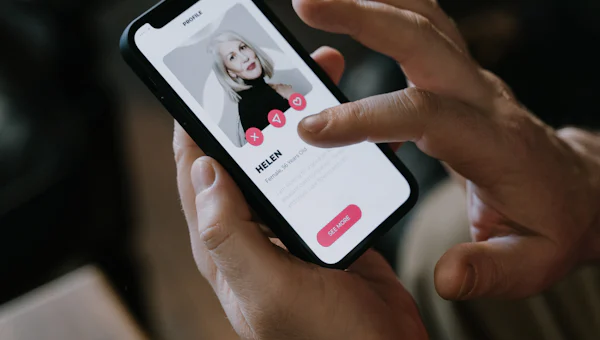
Person using dating app on smartphone
The press release language deserves flagging here. Like Love describes a 'growing segment' of real-world-first dating services and a 'new wave of companies' pursuing this model, but the evidence for either claim is absent. Closer and It's Just Lunch are cited as comparables, which hardly constitutes a wave. The company's assertion that it has 'established traction offline' means nothing without figures attached. Dating Industry Insights requested user and revenue data from Like Love; the company declined to provide specifics.
What this means for operators
For established dating operators watching this space, the lesson isn't that events are irrelevant. Bumble has experimented with in-person gatherings as member engagement tools. Hinge ran pop-up dating events in London and New York in 2023. These work as brand activations and retention plays, not as standalone revenue streams.
The actual test of Like Love's model won't come from its app launch. It will come 18 months from now, when the company either raises a Series A with credible metrics or quietly pivots again. The challenge for any events-first business is proving that the operational complexity and cost base are justified by meaningfully higher lifetime value or lower churn compared to app-only competitors. Nothing in Like Love's brief history or vague public statements suggests it has cracked that equation.
Investors tracking MTCH and BMBL should view this as noise rather than signal. The dating incumbents face real challenges—plateauing engagement, commoditisation concerns, AI integration uncertainty—but a year-old startup launching an app to support its events business isn't one of them. If anything, it's validation that pure offline models can't achieve venture-scale returns without digital infrastructure. The app isn't an evolution of the business model. It's an admission that the original model wasn't enough.
Like Love's pivot to app development after one year signals that events-only models lack the scalability and revenue potential required for venture-scale returns
The real test for hybrid dating models comes in proving that operational complexity justifies meaningfully higher lifetime value or lower churn than app-only competitors—a case Like Love has yet to make
Watch for Series A fundraising attempts in 18 months as the indicator of whether this model has genuine traction or becomes another cautionary tale in dating industry pivots